
PENINNIS FARMLAND WALK – OLD TOWN CHURCHYARD – LOWER MOORS – PORTHLOO – COAST PATH GOLF COURSE – TELEGRAPH – NEWFORD DUCKPOND – PORTHCRESSA
WEATHER: very windy, lots of sunshine, top temp 17C
A bright, sun-shiny morning, found us on a Farm Trail off the main track to Peninnis Head. We were looking for a Little Bunting that had been seen last night, it was feeding in a field with 50+ Meadow Pipits. We quickly found the Pipit flock and scanned through them looking for the Bunting. After 30 minutes we realised that the Bunting wasn’t there, we found an odd-looking Wagtail, probably a Grey Wagtail, but it had a short tail, a double wing-bar and it never bobbed its tail in its characteristic manner. All kinds of possible species ran through our discussion, but we eventually settled on an odd Grey version.
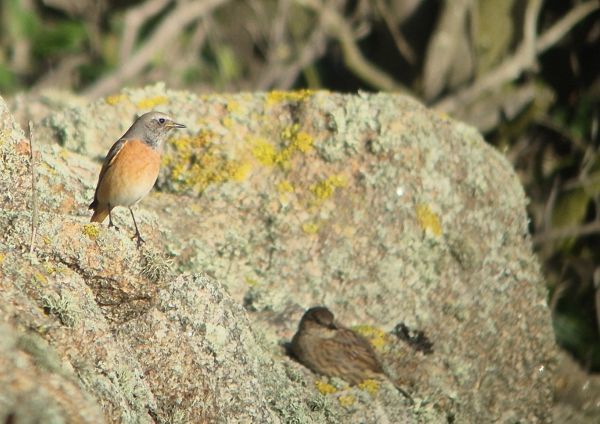
Common Redstart with a Dunnock
We found a Common Redstart sunning itself on a wall with a Dunnock and Linnet and Goldfinches flew over. We then followed the farm-trail down to the coastal path that leads into Old Town, in a sheltered area at the bottom we found several Blackcaps feeding on Blackberries with Green finches, a Pied Flycatcher sat out in the morning sun.
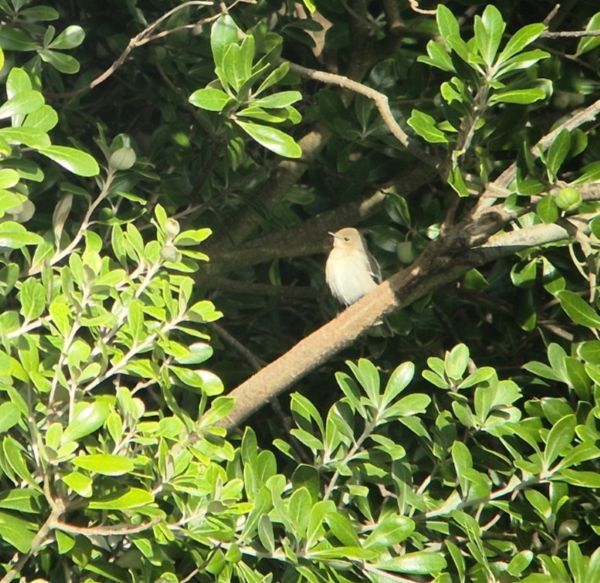
Pied Flycatcher
A quick look in the ‘Standing Stones’ field produced nothing and the hide on Lower Moors also had zilch to offer. At the Shooter’s Pool blind we watched our first Water Rail, a Cetti’s Warbler called and a Grey Wagtail briefly appeared.
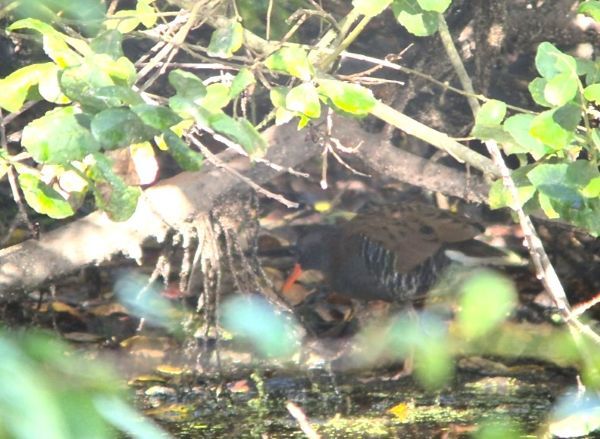
can you see a Water Rail here?
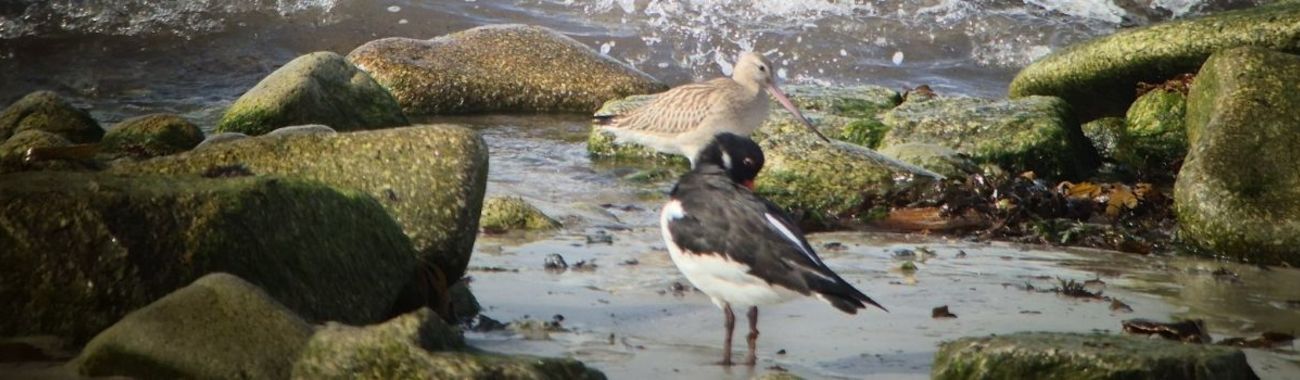
As we walked along Porthloo Road the first of the showers came down, it was quite heavy but short-lived. At the beach at Porthloo we noted the usual waders: Oystercatchers, Bra-tailed Godwit, Turnstone and Ringed Plover. Also present, were Med Gulls, Grey Heron, Little Egret, White Wagtail, Rock Pipit, Greenfinches and the usual larger gulls.
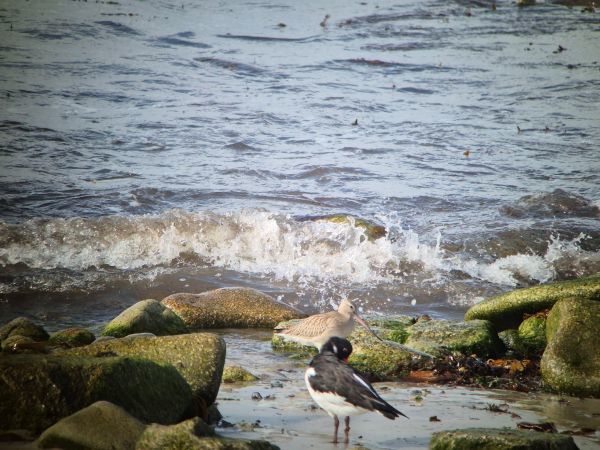
Bar-tailed Godwit with an Oystercatcher
We walked up to Juliet’s Café for lunch before taking the coastal path around the Golf Course, our aim was to try and see a Dotterel which was closely associating with a Eurasian Golden Plover. We had glimpses of them but nothing prolonged, they disappeared behind a ridge. Also on the Golf Course we saw several Northern Wheatears, Stonechats and more Meadow Pipits.
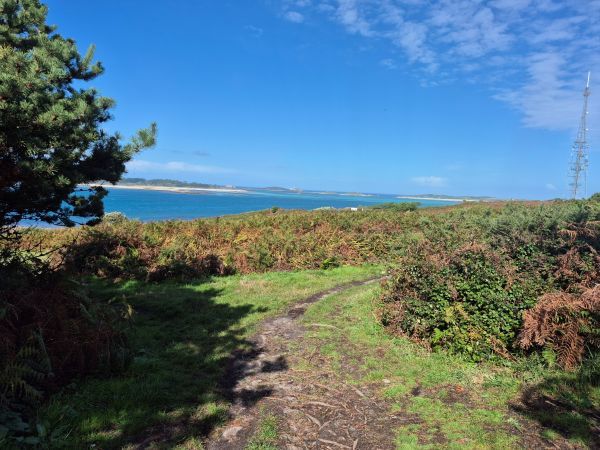
the view across to Tresco and St Martins from the coastal path around the Golf Course
We continued our walk up to Telegraph and then onto Newford Duck Pond, we joined other birders who were searching for a Yellow-browed Warbler, the warbler wasn’t home, we spent an hour knocking on his door, but he was obviously elsewhere. We saw Moorhen and Grey Wagtail for our efforts.
Back at Telegraph we had a short quick view of two Turtle Doves before we returned to the view-point over the Golf Course. This time both of the target birds were in sight, very distant but giving good views in the scope. At one time they both took off, did a circle over the sea and dropped back down again, fantastic! We had put in a lot of effort for these birds and it was paying off.
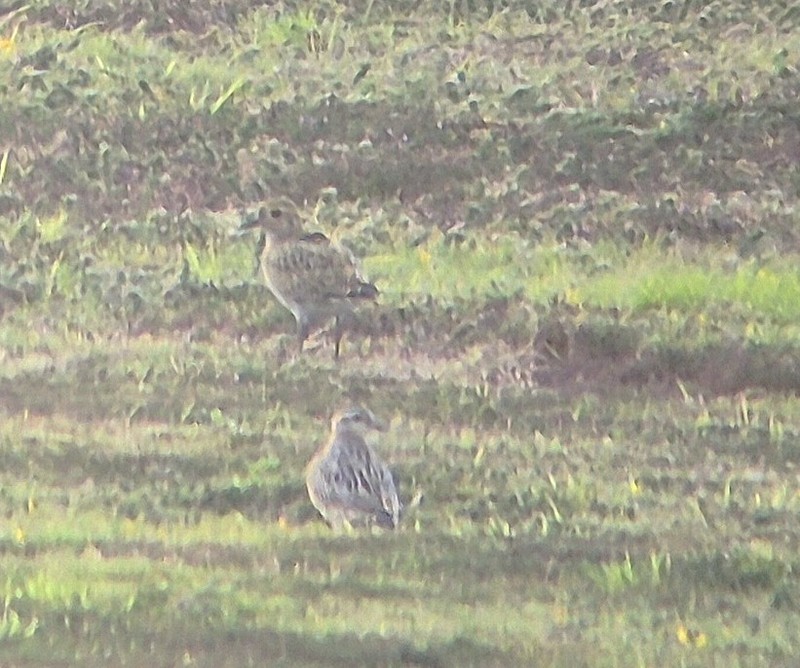
Eurasian Dotterel with a Eurasian Golden Plover
As an added bonus we all got to see a Whinchat! Up until now it was only Rob and myself who seen one, now everyone saw a distant one in the scope.
We walked back along the coast down to Porthloo where we split up. Neville, Peter, Anne and Rob set off for town whilst Lyn headed to Porthcressa to look for a Common Scoter in the bay and a Wryneck up by Buzza Tower.
I walked back to the guest house and after five minutes Lyn buzzed me, she had seen the Scoter. I walked round to Buzza Tower where I had an excellent view of the bay at Porthcressa. The Scoter was still present, Lyn joined me and we enjoyed some good views of the sea-duck. It was lovely out there, the afternoon sunlight was superb, the wind had died down and the scenery was fantastic.
For dinner we had a take-away, some had fish and chips, others had pizza and we enjoyed a nice tub of ice-cream for ‘afters’. Whilst eating our ice-cream Lyn noticed a large moth feeding on the flowers outside the dining room window, we dashed out to find a huge Convulvulus Hawk Moth hovering over the flowers. It feeds like a Hummingbird Hawk Moth, only at night, and it is 4 or 5 times bigger, wowza!!
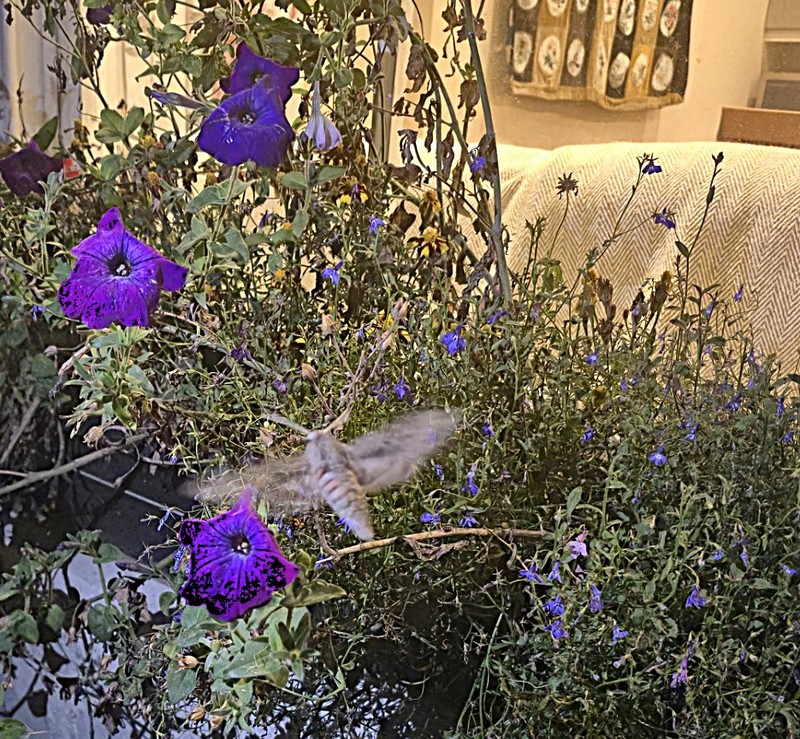
Convulvulus Hawk Moth